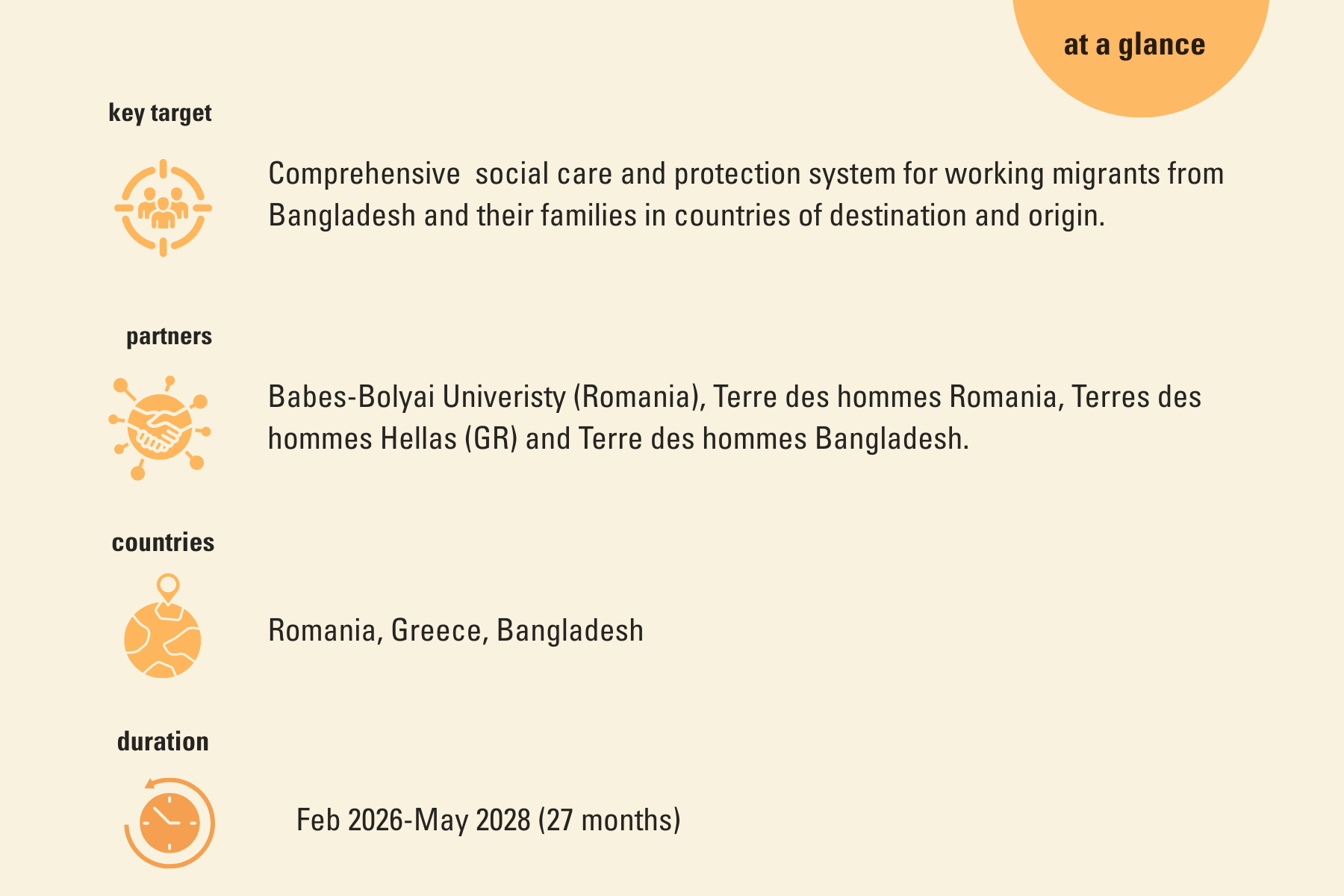
‘Caring for the Vulnerable - Transnational Social Protection of Bangladeshi Migrants’ Families in the EU – CASTLE 2’ is a research-driven project aimed at creating a more integrated, cross-border social protection framework for Bangladeshi labour migrants living in Romania and Greece or considering migration to the EU.
Labour migration from Bangladesh to European Union Member States has increased significantly in recent years, particularly towards emerging destination countries such as Romania and Greece. While migration offers important livelihood opportunities, Bangladeshi migrants and their families face persistent vulnerabilities throughout the migration cycle.
Building on the knowledge gathered through the ‘Children Left Behind by Labour Migration’ (CASTLE) project and recognising that migrants rely on both formal and informal support systems across origin and destination countries, CASTLE 2 will examine how these mechanisms interact for Bangladeshi migrants’ transnational families in Bangladesh, Romania, and Greece, and identify gaps in protection.
The findings will inform practical interventions to strengthen social protection throughout the migration cycle by improving access to information, building service providers’ capacity across all three countries, and engaging host communities to promote integration. The evidence generated will also be used to raise awareness among policymakers and the public, both nationally and at the EU level, and to inform targeted policy recommendations.
Overall Objective 
To improve access to rights, services, and protection for Bangladeshi labour migrants and their transnational families, with a particular focus on Hybrid Transnational Social Protection.
Specific Objectives
1. To enhance understanding and engagement of key stakeholders—academics, policymakers, service providers, civil society, and transnational families—in addressing HTSP needs.
2. To strengthen the capacity of social service providers and professionals in Romania and Greece to support the protection and integration of Bangladeshi migrants and their families.
3. To empower Bangladeshi transnational families through accurate information, awareness-raising, and community-based support related to safe migration, integration, and well-being.
Target Groups and Beneficiaries
Primary Beneficiaries • Bangladeshi labour migrants residing in Romania and Greece • Family members of migrants, including women, children, and youth, both in host countries and in Bangladesh.
Secondary Target Groups • Social protection providers, local authorities, and professionals working with migrants in Romania and Greece • Bangladeshi recruitment actors and intermediaries • Civil society organisations, researchers, and community leaders • Media professionals covering migration-related issues
Activities
1. Research and Evidence Generation
Migrants will act as co-researchers through action research to identify the mechanisms and resources that Bangladeshi migrants and their families use to protect and support themselves before, during, and after labour migration. This will enable the project to map where and why protection gaps occur in Bangladesh, Romania, and Greece.
2. Capacity and empowerment
Drawing on the research findings, this project will develop and deliver tailored training curricula to address capacity gaps among local service providers and professionals in Romania, Greece, and Bangladesh, enabling them to better support the social protection and integration of Bangladeshi transnational families. Furthermore, it will equip migrants and their families with information and opportunities to make informed choices, mitigate migration-related risks, and integrate more effectively in destination countries.
3. Multi-level Stakeholder Engagement and Awareness Raising
The initiative will engage policymakers and other stakeholders, including migration practitioners, trade unions, and employers’ organisations, from both origin and destination countries. Through high-level roundtables, peer learning, and cross-border dialogues, it will share insights generated by the project research, fostering policy change and more protective frameworks for Bangladeshi transnational families. Additionally, a multimedia awareness-raising campaign across the target countries and at the EU level will increase public understanding and support for the protection needs and rights of migrant communities.
For more information, please contact Panagiota Kanellopoulou, Access to Justice Project Coordinator at [email protected]